Spec Diff
Compare two .zwag files side-by-side to see what changed and whether it's breaking. Built for PR review.
How to compare
- Click Compare in the top bar.
- Pick the "before" spec file (e.g. the version from
main).
The diff panel opens. Your current in-app spec is treated as "after"; the file you picked is "before."
What counts as a change
Endpoints
Matched by (method, path). Presence changes:
- Only in "before" → removed → breaking.
- Only in "after" → added → non-breaking.
- In both → changed, categorized by detail.
Detail-level breakage (non-exhaustive; the complete list is in docs/specs/done/2026-04-18-spec-diff.md in the repo):
- New required param, or an optional param becoming required → breaking.
- Request body added, or its type narrowed → breaking.
- A response type at an existing status changed → breaking.
- New optional param, description change, tags change, new response status → non-breaking.
Types
Matched by name.
- Type removed and referenced by any endpoint → breaking. Unreferenced removal → non-breaking.
- Type added → non-breaking.
- Object: field removed, field added as required, field flipped optional→required, field type changed → breaking. Inverse non-breaking.
- String: enum shrunk,
patternadded or tightened,minLengthup /maxLengthdown → breaking. - Number:
minup,maxdown, enum shrunk → breaking.
What you see
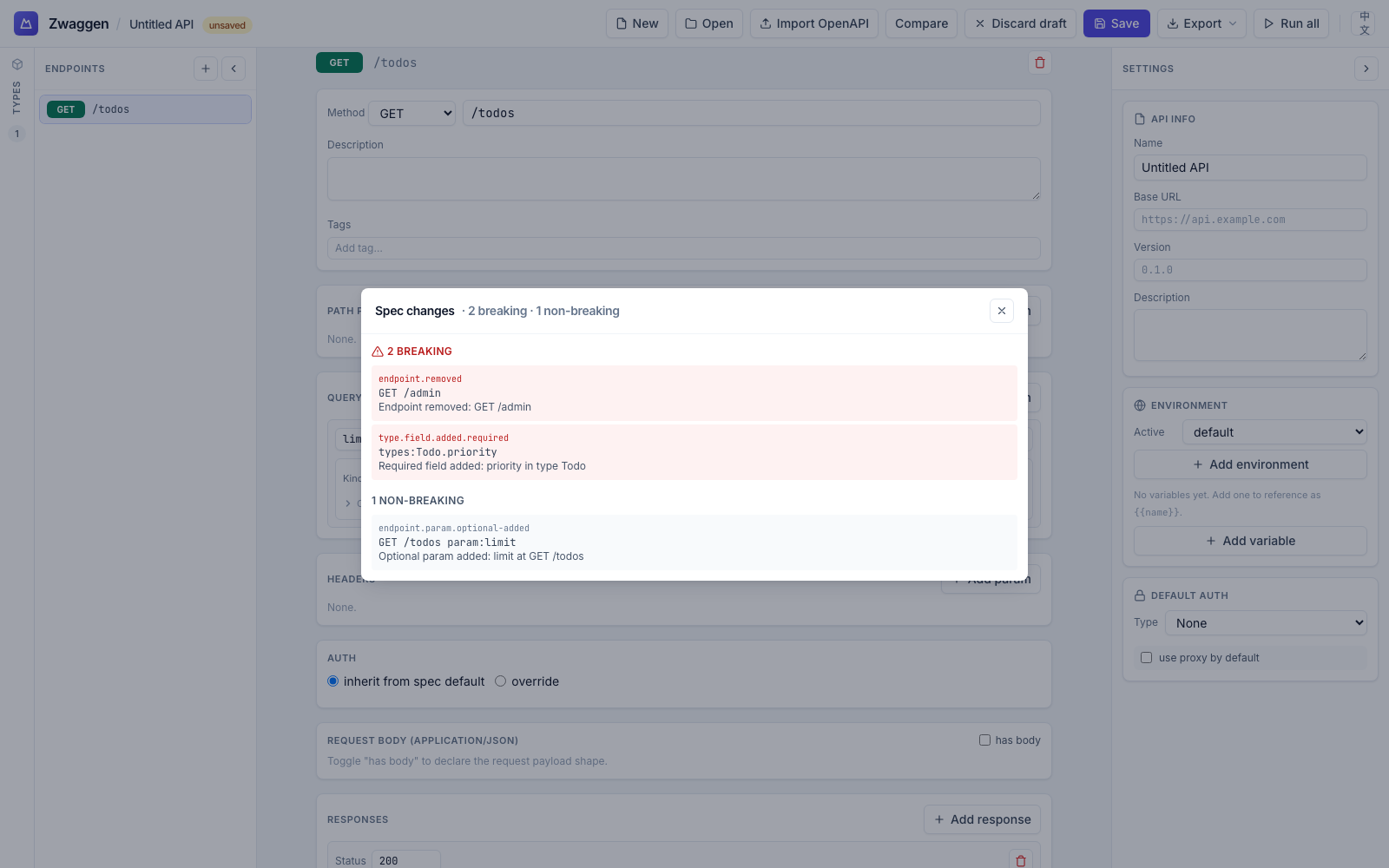
- Header: "N breaking, M non-breaking changes."
- Two sections: Breaking (red chips) and Non-breaking (slate chips).
- Each row:
[kind]chip + location (e.g.POST /users) + one-line summary.
What it won't tell you
- Not a full structural diff — whitespace and ordering are ignored.
- No migration guide. It categorizes, it doesn't prescribe fixes.
- Only two specs at a time.
- No git integration — you pick the "before" file yourself.
Typical use
- PR review. Before approving a spec change, compare the PR branch's
.zwagagainstmain's. Anything in the red bucket deserves a breaking-change note in the PR body. - Pre-release gate. Compare the about-to-ship spec against the last-released one; if there are breakers, bump the major version of the API.